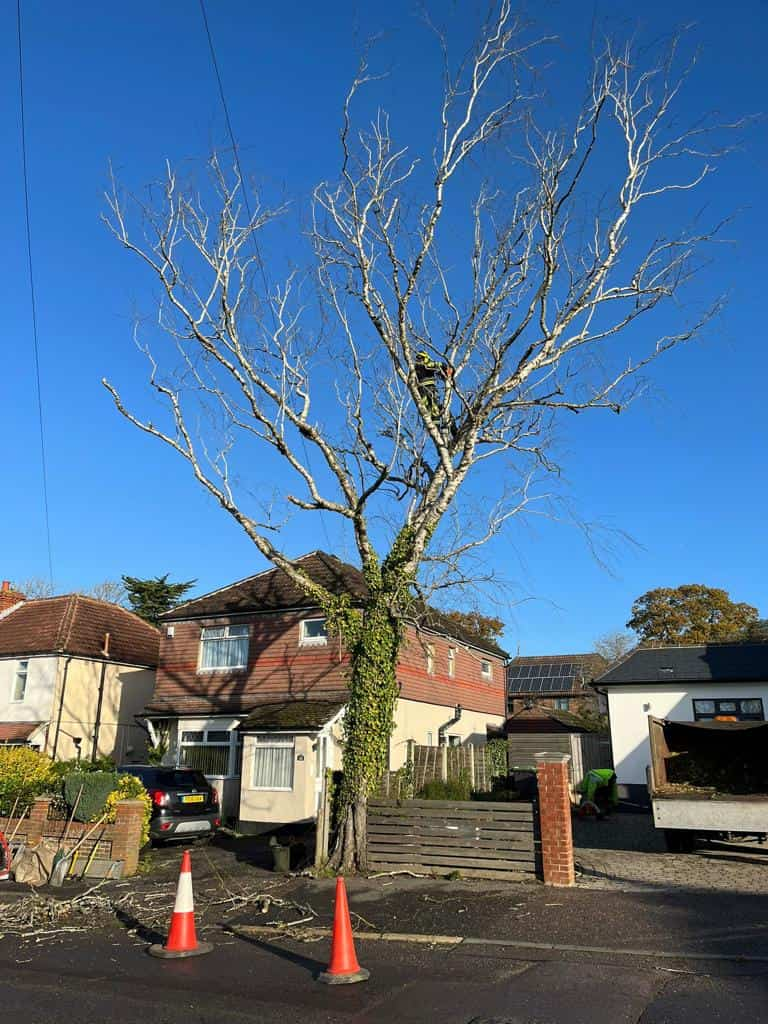
Deadwood removal is the selective cutting of branches that have died but remain attached to a tree. It is a common tree surgery service used to manage weakened branches, improve the condition of the canopy and reduce the likelihood of dead limbs falling into frequently used areas.
Not every piece of deadwood requires immediate removal. The appropriate approach depends on the branch’s size, position, condition and surroundings. A professional assessment helps identify which branches should be removed and which can reasonably remain.
Understanding Professional Deadwood Removal
Dead branches no longer receive the water and nutrients needed to sustain living tissue. As the wood dries and deteriorates, it can become increasingly brittle. Deadwood removal involves locating these branches and cutting them back to suitable points without unnecessarily damaging healthy growth.
Why Do Trees Develop Deadwood?
Trees can develop dead branches for many reasons. Some deadwood is part of the natural process through which a tree sheds growth it can no longer support.
Other possible causes include:
- Shading within a dense canopy
- Storm or impact damage
- Drought and environmental stress
- Root disturbance
- Disease or decay
- Damage caused by poor pruning
- Competition between closely growing branches
- A general decline in tree health
A tree surgeon will consider why the branch has died rather than treating every dead limb as an isolated problem.
How Can You Recognise a Dead Branch?
A dead branch may remain bare while the rest of the tree produces healthy leaves. However, the absence of foliage alone is not always conclusive, particularly during dormancy or when some branches develop later than others.
Common signs include:
- Brittle twigs that snap easily
- Missing buds during the growing season
- Dry or peeling bark
- Wood that appears cracked or bleached
- Fungal growth around the branch
- No flexible green tissue beneath the bark
- Repeated shedding of small twigs
- Decay where the branch meets the trunk
A closer professional inspection can distinguish deadwood from dormant, stressed or declining growth.
When Is Deadwood Removal Most Important?
Position is often more significant than the amount of deadwood present. A weakened branch above a path, driveway, seating area, entrance or building usually requires greater attention than a similar branch over an unused section of ground.
Removal may be appropriate when:
- A large dead branch extends over a frequently used area
- The branch is cracked or partly detached
- Deadwood has become suspended in the canopy
- Several dead branches are falling regularly
- The branch could damage healthy growth if it breaks
- Deadwood is obstructing access or interfering with structures
- The cause of widespread dieback needs investigating
An assessment should be arranged promptly if a branch is hanging, visibly split or has changed position after strong winds.
Does All Deadwood Need to Be Removed?
Deadwood can provide useful habitat within a tree, particularly where it can remain without creating an unacceptable concern. For this reason, completely stripping every dead branch from a tree is not always necessary or desirable.
Professional tree surgery balances the condition of the tree with the way the surrounding space is used. Selected deadwood may be retained where it is stable and suitably positioned, while branches above higher-use areas are removed.
How Is Deadwood Removed?
The method depends on the tree’s height, branch size and available working space. A tree surgeon may use climbing equipment or a suitable access platform to reach the canopy safely.
Smaller branches can be removed with pruning tools, while heavier limbs may need to be dismantled in controlled sections. Ropes can be used to lower cut material where allowing it to fall freely could damage the garden or nearby structures.
Correct Cuts Help Protect Healthy Wood
Dead branches should be removed at an appropriate point without cutting unnecessarily into the trunk or supporting limb. The branch collar—the slightly enlarged area where a branch joins the tree—should normally be preserved.
Cutting too close can create an unnecessarily large wound, while leaving an excessive stub can result in untidy decay. Skilled pruning aims to remove the dead section cleanly while limiting disturbance to living tissue.
Deadwood Removal Is Not the Same as Crown Reduction
Deadwood removal targets branches that have already died. Crown reduction, by comparison, shortens selected living branches to reduce the tree’s overall height or spread.
A tree may need deadwood removal without requiring any reduction in size. In other cases, several operations may be combined where the canopy is overcrowded, damaged or unsuitable for its surroundings.
What Can Deadwood Reveal About Tree Health?
One or two dead branches do not necessarily indicate a serious problem. However, widespread or recurring dieback deserves closer investigation.
A tree surgeon may inspect the canopy, branch unions, trunk and visible root area for signs such as:
- Deadwood concentrated on one side
- Cavities or decayed sections
- Fungal growth
- Sparse or undersized foliage
- Cracks in major limbs
- Bark loss
- Changes in the tree’s position
- Further dieback following earlier pruning
Identifying the underlying cause helps determine whether deadwood removal alone is sufficient.
Why Professional Assessment Matters
Dead branches can be difficult to distinguish within a dense canopy, particularly when viewed from ground level. Their strength and attachment also cannot be judged reliably by appearance alone.
A professional tree surgeon can identify the relevant branches, choose an appropriate access method and remove them in a controlled sequence. The wider condition of the tree can be assessed at the same time, providing clearer guidance on any further work that may be beneficial.
Conclusion
Deadwood removal is the selective pruning of branches that have died and remain attached to a tree. It is particularly valuable where weakened limbs extend above areas used by people, vehicles or nearby structures. The work should be proportionate, retaining suitable deadwood where appropriate while removing branches that require attention.
NS Tree Surgery Ashtead provides professional tree inspections and deadwood removal in Ashtead, Surrey. If you have noticed bare, brittle or damaged branches, contact us to arrange an assessment and determine the most suitable approach.
Call us on: 01372 679 991
Click here to find out more about NS Tree Surgery Ashtead
Click here to complete our contact form and see how we can help with your trees needs.